• Sign Up! To view all forums and unlock additional cool features

    Welcome to the #1 Explorer ST Forum and Explorer ST community dedicated to Explorer ST owners and enthusiasts. Register for an account, it's free and it's easy, so don't hesitate to join the Explorer ST Forum today!


Rear clunk after lowering

Messages
3
Reactions
2
Points
2
Location
New york
Vehicle
2023 explorer ST
#1
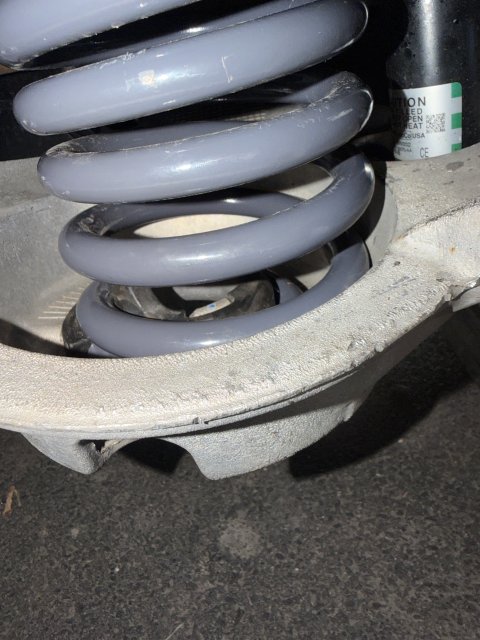
Hello I had lethal lowering springs put on a week ago. I am now feeling a clunk on the rear passenger side when I’m going slow over uneven ground and turning right. I have checked the sway bar links, and even fully disconnected them to test it and the noise persists. I can’t tell if the springs are seated correct, but from what I can tell they are. Any ideas?
 

Attachments

Messages
3,338
Reactions
1,479
Points
252
Location
Nevada
Vehicle
'20 Raptor, '22 Explorer ST, '14 GT500, '03 F150
#2
99.9% of the people that run into clunks didn’t seat them properly.
 

Messages
109
Reactions
46
Points
27
Location
MO
Vehicle
2026 ST AWD
#3
Hey, idkaboutthis,

The good news is that (most) lowering springs can be rotated if you lift the wheels off the ground. You'll see the pocket in the perch when looking up at the bottom of the perch. Stick a finger in there and the end of the coil should be 1/4" from the flat vertical end in the perch. If the gap is bigger, unload the rear end and rotate the spring (watch that the top isolator stays in place) until the coil end is in the desired position (1/4" gap to the perch end). Repeat on the other side. Lower the vehicle and go for a test drive.

Another possibility is that the springs are in upside down. Tighter coil is the one that goes on the top.

The last spring possibility is that the coils are contacting each other ("binding") over bumps. If this is the case, you'll need to get some sleeves to slide on the coil(s) to quiet things down. Forum member "SugarMouth" had a metallic noise coming from the rear and coil bind (contact between coils) was the problem. Here is a link to his thread.

Before you look at any of the three things listed, check that all fasteners are tight and properly torqued. Then take a good look around the rear and see if something is loose or is making contact now that the rear sits lower. Look for a witness mark where rubbing or contact is occurring. Use a floor jack and raise the rearend to decompress the springs, then lower the rear (quickly) to see if the noise can be generated.

If you want to check one side at a time, then put the rear up on jackstands and then put a floor jack under one tire, remove the floor jack on that side, and raise/lower the free side to see if the noise can be generated. Repeat to check the other side.

That's about all I can suggest for now. [cheers]

HTH.
 

OP
I
Messages
3
Reactions
2
Points
2
Location
New york
Vehicle
2023 explorer ST
Thread Starter #4
Hey, idkaboutthis,

The good news is that (most) lowering springs can be rotated if you lift the wheels off the ground. You'll see the pocket in the perch when looking up at the bottom of the perch. Stick a finger in there and the end of the coil should be 1/4" from the flat vertical end in the perch. If the gap is bigger, unload the rear end and rotate the spring (watch that the top isolator stays in place) until the coil end is in the desired position (1/4" gap to the perch end). Repeat on the other side. Lower the vehicle and go for a test drive.

Another possibility is that the springs are in upside down. Tighter coil is the one that goes on the top.

The last spring possibility is that the coils are contacting each other ("binding") over bumps. If this is the case, you'll need to get some sleeves to slide on the coil(s) to quiet things down. Forum member "SugarMouth" had a metallic noise coming from the rear and coil bind (contact between coils) was the problem. Here is a link to his thread.

Before you look at any of the three things listed, check that all fasteners are tight and properly torqued. Then take a good look around the rear and see if something is loose or is making contact now that the rear sits lower. Look for a witness mark where rubbing or contact is occurring. Use a floor jack and raise the rearend to decompress the springs, then lower the rear (quickly) to see if the noise can be generated.

If you want to check one side at a time, then put the rear up on jackstands and then put a floor jack under one tire, remove the floor jack on that side, and raise/lower the free side to see if the noise can be generated. Repeat to check the other side.

That's about all I can suggest for now. [cheers]

HTH.
When I feel in the bottom it’s tight to the perch, I’ll try rotating it 1/4” away, thank you!
 

Messages
47
Reactions
21
Points
2
Location
So Cal
#5
Take it back to whoever did it for you
 

OP
I
Messages
3
Reactions
2
Points
2
Location
New york
Vehicle
2023 explorer ST
Thread Starter #6
Take it back to whoever did it for you
I did, they were unable to fix it and believe the spring has an issue, which I agree with after getting under it earlier, the second coil is hitting the control arm which seems to be an issue with lethal springs. I thought they had fixed it but it seems not, or I got an old batch. Waiting for lethal to reply, going to use a spring silencer in the meantime time
 

Messages
109
Reactions
46
Points
27
Location
MO
Vehicle
2026 ST AWD
#7
When I feel in the bottom it’s tight to the perch, I’ll try rotating it 1/4” away, thank you!
idkaboutthis,

/edit:/
I see a couple of messages were posted since I was leisurely typing mine. I hope Lethal comes through for you.
/end of edit/

The Service Manual says '1/4" gap', that's where I got the number. A quick check tonight and I don't feel much gap between the perch wall and the rubber spring bumper. I think there was more gap to fit my pinky when I installed the springs (a few months ago).

From the second photo, the spring looks snug on the outboard side. Also, the rubber bumper looks higher inside the spring on the inboard side. The snug fit could be causing the spring to stick (vertically) initially and the rubber boot being higher inside the spring leaves less rubber on the outside of the spring.

Suggest that the passenger side rear is jacked to let the tire droop. Wrap a prybar in masking tape or electrical tape (to protect the paint on the spring) and push the spring inboard a little (if you can). Next thing is to wrestle the rubber bumper to move it down on the inside and higher on the outside. Not sure this is doable with the spring in place although the [long] prybar can be used to take some pressure off the lowest coil. Maybe a little spritz of silicone spray lube would help, too, to adjust the bumper.

HTH.


Top